

A valley of houses, not the town grid
Houses are detached, on lots with trees close to the eaves. Asphalt is usual. An older place has a chimney and a small roof over the door. That lower roof meets the wall and leaks into the entry while the main slopes look fine.
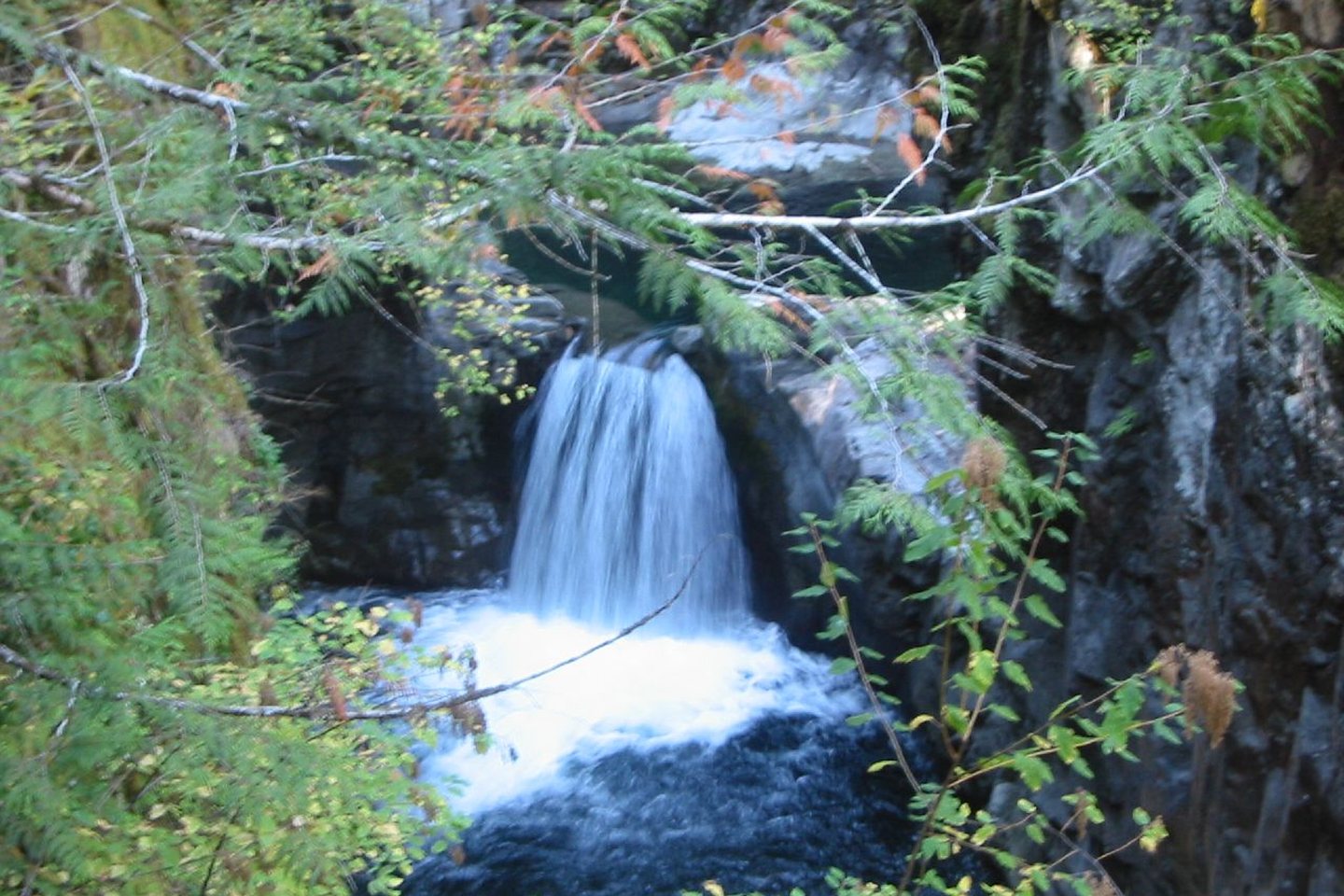
The falls are the landmark, not the roof. Your house may be well back from the river. Give the road, not only the falls.
A cabin that became a full-time house often kept the original small roof and added a room. The joint is the leak. You can see the newer siding against the old from the yard.
Shade and a long wet season
Very little sun reaches some of these slopes. Moss grows on anything that faces north or sits under firs. A green slope can still be waterproof. A clean slope can still leak at one flashing. If you scraped the moss and the ceiling marked again, say the scraping did not stop it.
Needles in the valley hold rain against the laps. If you can see the valley from a side yard, look into it. A packed valley is worth a sentence.
Wind is not the main event unless your lot is open to the west. Most calls here are rain finding a crack, or a gutter that overflowed.
The details that help
Little Qualicum and the road, first. Then the room. Then trees or a clearing.
A narrow bridge of a driveway, a soft shoulder, or a dog at the gate changes the arrival. Say the one you have.
Photos from the yard of the eave and of the stain. Stay down. If the shingles are pale and gritty, say the slope looks tired. If they are dark, say one spot.
Around the house
The falls pull visitors onto the trails. Your house may be on a road those visitors never see. Give the road, and say if the driveway is easy to miss in the dark under the trees. A roof you cannot see from the pavement still needs a sentence about how to find the house.
Moss on a north slope in this valley comes back every year. Scraping it is maintenance. A stain that returns the same week is not. Say if you already scraped and the ceiling still marked.
A single slope toward the river dumps rain at one eave. Look at what that eave overhangs: a path, a bedroom window, a woodshed. Name it. The woodshed can be wet while the house stays dry.
Visitors park near the falls and walk. Your roof is not that trail. If the drive leaves the main road and crosses a culvert, say culvert. In a heavy rain it is the thing a truck notices. The valley above it, on the roof, is where needles collect and where the ceiling stain often starts.
Visitors walk the falls. Your roof is on a road they do not use. If the drive crosses a culvert, say so. Needles collect in the valley above it, and that is often the ceiling stain. A woodshed at the eave can be wet while the house stays dry.
Questions
Is this Qualicum Beach?
No. The falls and the river are their own place. Say Little Qualicum so the roofer does not look for you in town.
What should I check?
The gutter and the valley, from the ground. Needles there explain a lot of ceiling stains.
What do I tell you?
Little Qualicum, the road, the wet room, and whether a tree overhangs that side.
How much does roof repair cost in Little Qualicum?
Cost depends on the roof size, layers and access. A small leak repair is a different quote than a reshingle. Call and the roofer gives a number after hearing what is wet.
How fast can a roofer come out in Little Qualicum?
Emergency leaks get priority. No one can promise a same-day visit. Read emergency roof repair before the visit if Little Qualicum is taking water.